Demystifying Database Impedance Mismatch: A Simple, Straightforward Guide
An application may work with a graph of objects while its SQL database stores rows in tables. The effort needed to map between those models is called object-relational impedance mismatch.
This is not primarily about two databases using different file formats. It is about the boundary between the application's object model and the relational model used for persistence.
A small example
Imagine an Order object containing a Customer reference and a list of OrderLine objects. In a relational design, those could be three tables:
| Table | Example columns |
|---|---|
| customer | id, name |
| orders | id, customer_id, created_at |
| order_line | id, order_id, product_id, quantity |
The object has references and a collection. The database represents those relationships with keys. Reading an order means deciding which rows to fetch and how to assemble them into objects. Saving it means deciding which inserts, updates and deletes belong in the transaction.
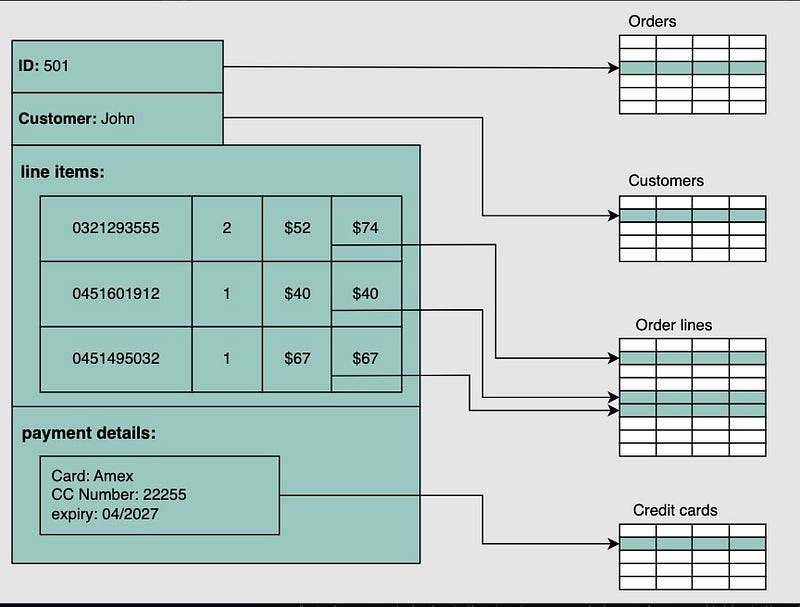
Object-to-table mapping illustration. Source: Educative, as credited in the original article.
Where the mismatch appears
- Identity: two Java objects may represent the same database row. Object identity and primary-key identity are different concepts.
- Relationships: object references become foreign keys or join tables. Bidirectional object relationships need care on both sides.
- Inheritance: a class hierarchy needs a relational mapping strategy, with trade-offs in joins, duplication and constraints.
- Data access: walking object references can accidentally trigger many database queries. A query that fetches the needed data together may be better.
- Types and constraints: nullability, decimal precision and date/time handling must agree across application and database boundaries.
Ways to manage it
Use an ORM where it helps. Hibernate maps entities and relationships and tracks changes. It does not remove the need to understand SQL, transaction boundaries or the queries it generates.
Use explicit SQL or data mappers where control matters. For reporting or complex reads, projecting directly into a small result object can be simpler than loading a large entity graph.
Design the boundary deliberately. Keep transaction scope clear, choose what to fetch, inspect generated queries and test with realistic data. Watch for N+1 queries, where loading a list causes an additional query for every item.
Choose a database for the access patterns. A document database can fit some aggregate-shaped data well, but changing database type does not eliminate every modeling or consistency trade-off.
The point
The relational model is not broken, and an object model is not automatically a good database schema. They serve different purposes. The useful question is how to make the mapping explicit enough that correctness and performance remain understandable.